



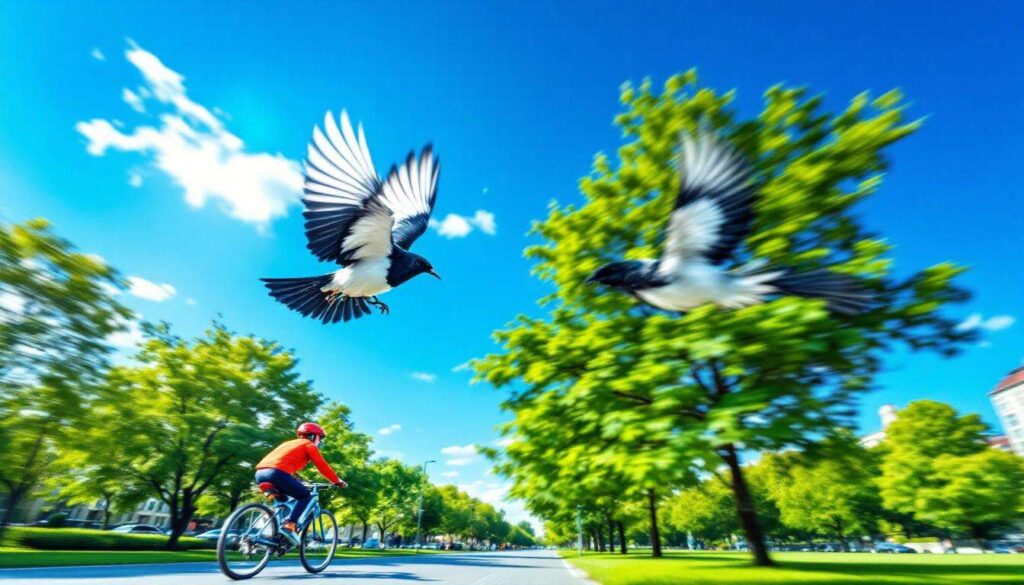
Every spring and summer, countless cyclists, joggers, and pedestrians across Australia experience the startling phenomenon of being dive-bombed by magpies. These intelligent corvids have earned a fearsome reputation during breeding season, yet they don’t attack everyone equally. Some individuals walk through magpie territories completely undisturbed, while others are singled out for aggressive swooping. Understanding why magpies target specific people requires examining their protective instincts, environmental cues, and the complex relationship between these birds and humans.
Defensive behavior of magpies: a protection strategy
Parental instinct drives territorial aggression
Magpies exhibit swooping behavior primarily as a defensive mechanism to protect their nests and offspring. During the breeding season, which typically spans from August to October in Australia, male magpies become intensely protective of their territory. This aggression is not random violence but rather a calculated survival strategy that has evolved over thousands of years. The birds perceive anyone entering their territory as a potential threat to their vulnerable chicks and eggs.
Research indicates that only approximately 10 percent of male magpies actually engage in swooping behavior. These individuals tend to be particularly territorial and have likely had negative experiences with humans in the past. The swooping typically begins when chicks hatch and continues until the young birds leave the nest, a period lasting roughly six to eight weeks.
The anatomy of a magpie swoop
When a magpie decides to swoop, the attack follows a predictable pattern. The bird typically:
- Approaches from behind to maximize surprise
- Flies within centimeters of the target’s head
- Produces loud clicking or warbling sounds to intimidate
- Occasionally makes physical contact with beak or claws
- Repeats the behavior until the perceived threat leaves the area
The intensity of these attacks varies considerably. Some magpies merely fly close as a warning, while others make direct contact, potentially causing injury. The bird’s goal is not to harm but to drive away the intruder as quickly as possible.
Understanding this protective behavior helps explain why magpies develop specific targeting patterns based on perceived threat levels.
Trigger factors for magpie attacks
Movement patterns and speed
The way a person moves through magpie territory significantly influences whether they become a target. Rapid movement triggers a stronger defensive response because it suggests urgency or predatory behavior. Cyclists and runners are disproportionately targeted compared to people walking slowly. The quick, unpredictable movements associated with jogging or cycling activate the magpie’s threat detection system more readily than calm, steady walking.
Previous negative encounters
Magpies possess remarkable memory capabilities and can recognize individual human faces. If a magpie has had a negative experience with a particular person, such as someone who threw objects at their nest or made threatening gestures, the bird will remember that individual and target them specifically in future encounters. This facial recognition ability has been documented in scientific studies, demonstrating that magpies can distinguish between hundreds of different people.
Visual and behavioral cues
Certain visual elements appear to trigger magpie aggression more than others. Factors that may increase swooping risk include:
- Direct eye contact, which magpies interpret as confrontational
- Waving arms or objects overhead
- Loud noises or shouting
- Bright or reflective clothing and accessories
- Sudden changes in direction or speed
These behavioral and visual triggers help magpies assess threat levels and determine appropriate defensive responses, leading to distinct patterns in who gets swooped.
Profile of people targeted by magpies
Demographic patterns in swooping incidents
Statistical analysis of magpie attacks reveals interesting patterns. Men are targeted more frequently than women, possibly due to differences in average height, gait, or behavioral patterns when moving through magpie territories. Children also experience higher rates of swooping, likely because their unpredictable movements and higher-pitched voices trigger stronger defensive responses.
| Group | Swooping Frequency | Severity Level |
|---|---|---|
| Male cyclists | High | Moderate to severe |
| Female cyclists | Moderate | Low to moderate |
| Joggers | High | Moderate |
| Pedestrians | Low | Low |
| Children | Moderate to high | Variable |
Behavioral characteristics of targeted individuals
People who display nervous or defensive behavior around magpies often become repeat targets. Those who duck, wave their arms, or run when a magpie approaches reinforce the bird’s perception that they pose a threat. Conversely, individuals who remain calm and continue moving steadily through the territory are less likely to trigger aggressive responses.
The relationship between individual behavior and magpie responses is heavily influenced by the surrounding environment and its characteristics.
The role of the environment in magpie behavior
Urban versus rural territories
Magpies in urban environments generally exhibit more aggressive swooping behavior than their rural counterparts. This heightened aggression stems from increased human activity, reduced territory size, and more frequent disturbances. Urban magpies encounter humans constantly, leading to more opportunities for negative interactions and the development of defensive behaviors.
Territory size and nesting locations
The location and accessibility of magpie nests directly influence swooping patterns. Nests positioned near high-traffic areas such as bike paths, playgrounds, or walking trails result in more frequent defensive episodes. Territory size also matters; magpies defending smaller territories tend to be more aggressive because threats are always in close proximity to their nests.
Seasonal and environmental factors
Environmental conditions affect magpie behavior in several ways:
- Weather patterns influence nesting success and parental stress levels
- Food availability affects overall aggression and territorial defense
- Presence of natural predators heightens defensive instincts
- Human feeding practices alter natural behavior patterns
These environmental influences combine with individual strategies to determine the safest ways to navigate magpie territories.
How to avoid magpie attacks
Practical prevention strategies
Avoiding magpie swoops requires understanding their behavioral triggers and adjusting accordingly. The most effective approach is to identify known swooping zones and plan alternative routes during breeding season. Many communities maintain online maps showing active magpie territories, allowing people to avoid these areas entirely.
When avoiding swooping zones isn’t possible, several strategies reduce attack risk:
- Walk rather than run through magpie territories
- Travel in groups, as magpies are less likely to attack multiple people
- Maintain a calm, steady pace without sudden movements
- Avoid making direct eye contact with swooping birds
- Carry an open umbrella or wear a wide-brimmed hat for protection
Protective equipment and modifications
Cyclists face particular challenges during swooping season. Helmet modifications such as cable ties or painted eyes can deter some magpies, though effectiveness varies. Dismounting and walking the bicycle through known swooping zones proves more reliable than any protective equipment. Some cyclists attach flags or streamers to their helmets, creating visual distractions that may reduce attack frequency.
Building positive relationships with local magpies
Establishing positive associations with magpies in your area can significantly reduce swooping risk. Regular, calm passage through their territory without threatening behavior helps magpies recognize you as non-threatening. Some people successfully befriend local magpies by offering small amounts of appropriate food, though experts caution against creating dependency or altering natural foraging behaviors.
These individual actions contribute to broader patterns of human-magpie interaction that shape bird behavior over time.
The impact of human interactions on magpies
Feeding practices and behavioral changes
Human feeding of magpies has created complex behavioral shifts in urban populations. While well-intentioned, regular feeding can increase aggression by concentrating birds in smaller areas and creating competition for resources. Fed magpies may also become more territorial as they defend valuable food sources, leading to increased swooping incidents.
Habitat modification and population dynamics
Urban development has fundamentally altered magpie behavior and distribution. Fragmented habitats force magpies into closer proximity with humans, increasing interaction frequency. Parks, golf courses, and suburban gardens provide ideal nesting sites but also guarantee constant human presence, creating ongoing tension during breeding season.
Conservation and coexistence strategies
Successful coexistence with magpies requires balancing human safety with bird conservation. Education programs help communities understand magpie behavior and reduce unnecessary fear. Temporary signage warning of active swooping zones allows people to make informed decisions about route selection. Some municipalities have implemented nest relocation programs for particularly problematic situations, though this remains controversial among wildlife experts.
Magpies represent both a challenge and an opportunity for understanding wildlife adaptation to human-dominated landscapes. Their selective swooping behavior reflects sophisticated threat assessment capabilities and remarkable memory. By recognizing the protective motivations behind swooping, understanding individual trigger factors, and modifying our own behavior accordingly, humans can safely share spaces with these intelligent birds. The key lies in respecting their territorial needs during breeding season while maintaining the calm, predictable behavior that signals we pose no threat to their vulnerable offspring.