



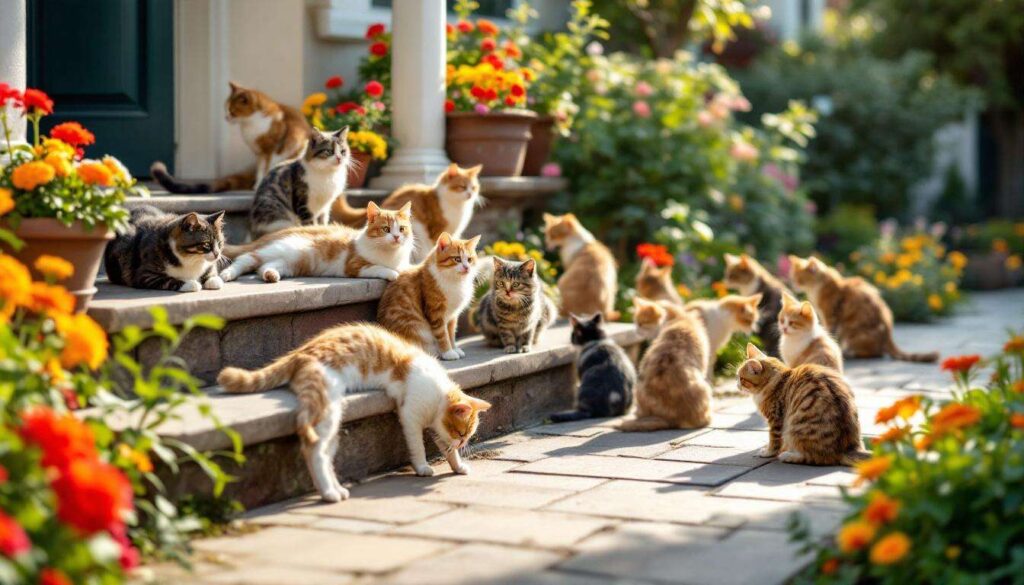
Domestic cats roaming through suburban neighborhoods have long been a familiar sight, but recent scientific investigations reveal these felines maintain complex social structures that researchers are only beginning to understand. Behind garden fences and beneath shrubbery, cats establish intricate relationships that challenge previous assumptions about their solitary nature. These discoveries shed light on how urban expansion affects animal behavior and the surprising adaptability of our feline companions.
Introduction to cat colonies in suburban gardens
Cat colonies represent organized groups of felines that share common territories and resources within residential areas. Unlike their reputation as independent creatures, these animals form semi-structured communities where multiple individuals coexist in relatively confined spaces. Suburban gardens provide ideal conditions for these colonies to flourish, offering shelter, food sources, and protection from larger predators.
Defining cat colonies
A cat colony typically consists of related or unrelated cats that inhabit a specific geographic area and interact regularly. These groups can range from just a few individuals to dozens of cats, depending on resource availability. The composition includes:
- Adult females and their offspring forming the core group
- Juvenile cats learning social behaviors
- Transient males visiting during mating seasons
- Established territorial males maintaining boundaries
Researchers distinguish between managed colonies, where humans provide regular care, and feral colonies, which survive independently. Both types demonstrate sophisticated social organization that extends beyond simple survival instincts.
Population dynamics in residential areas
Suburban environments support higher cat densities than natural habitats due to abundant anthropogenic resources. Food availability from intentional feeding, garbage, and small prey creates conditions where multiple colonies can exist within close proximity. This concentration allows researchers to observe behaviors that would be difficult to study in dispersed rural populations.
Understanding these foundational aspects of cat colonies sets the stage for examining the specific social behaviors that govern their daily interactions.
The social behavior of garden cats
Contrary to popular belief, cats demonstrate remarkable social complexity when living in colonies. Their interactions involve sophisticated communication systems, hierarchical structures, and cooperative behaviors that ensure group stability.
Communication methods
Garden cats employ multiple channels to convey information and maintain social bonds. These include:
- Scent marking through facial rubbing and urine spraying
- Vocal signals ranging from meows to complex trills
- Body language including tail positions and ear orientations
- Physical contact such as grooming and touching noses
These communication strategies help cats navigate shared spaces without constant conflict, establishing who belongs to the colony and defining individual roles within the group.
Hierarchical structures and relationships
Cat colonies exhibit fluid hierarchies based on factors including age, sex, and residency duration. Dominant individuals typically control access to prime resources like feeding stations and sheltered resting spots. However, unlike rigid dominance systems in some species, cat hierarchies allow for negotiated access where subordinate individuals can share resources during specific times.
Female cats often form the stable core of colonies, with matrilineal bonds creating subgroups that cooperate in raising kittens. Males generally maintain looser associations, with their involvement varying based on reproductive status and territorial claims.
These behavioral patterns provided the framework that enabled scientists to identify the hidden networks operating within seemingly random cat gatherings.
The hidden networks: how researchers discovered them
Scientific breakthroughs in understanding cat social networks resulted from innovative tracking technologies and observational methodologies that revealed previously invisible patterns of interaction.
Research methodologies
Scientists employed several approaches to map feline social structures:
- GPS collar tracking to monitor movement patterns and territory overlap
- Motion-activated cameras capturing nocturnal interactions
- Social network analysis algorithms identifying relationship clusters
- Long-term behavioral observations documenting individual interactions
These combined methodologies allowed researchers to construct detailed maps showing not just where cats went, but who interacted with whom and the nature of those interactions.
Key findings from recent studies
Research revealed that cat colonies operate through complex social networks with distinct characteristics. Studies documented cats maintaining regular contact with specific individuals while avoiding others, creating what scientists term preferred association patterns.
| Network Characteristic | Percentage of Colonies | Significance |
|---|---|---|
| Core social groups | 78% | Stable associations lasting months |
| Peripheral members | 65% | Temporary or seasonal connections |
| Bridge individuals | 34% | Connect separate subgroups |
Researchers discovered that certain cats act as social connectors, facilitating information flow between different parts of the network. These bridge individuals play crucial roles in maintaining colony cohesion and may help integrate new members into established groups.
These discoveries about social organization naturally lead to questions about why suburban gardens specifically support such elaborate cat communities.
Suburban gardens: a favored habitat for cats
Residential gardens provide optimal conditions for cat colonies through a combination of environmental features and human influence that creates sustainable habitats.
Environmental advantages
Gardens offer diverse microhabitats that meet multiple feline needs. The structural complexity of suburban landscapes includes:
- Dense vegetation providing concealment and hunting opportunities
- Vertical spaces in trees and structures for observation and escape
- Varied terrain creating territorial boundaries
- Protected areas under sheds and decks for shelter
This habitat diversity allows multiple cats to coexist by utilizing different spatial niches, reducing direct competition even in relatively small areas.
Human factors supporting colonies
Suburban residents inadvertently or intentionally create conditions that sustain cat populations. Food supplementation, whether through deliberate feeding or accessible waste, provides reliable nutrition that reduces hunting pressure. Additionally, many homeowners tolerate or welcome cat presence, viewing them as pest controllers or companions.
The intersection of suitable habitat and human tolerance creates population densities that have significant ecological consequences worth examining.
The ecological implications of cat colonies
Cat colonies in suburban gardens generate measurable environmental impacts that affect local ecosystems and biodiversity, raising important conservation questions.
Impact on wildlife populations
Domestic and feral cats are efficient predators that affect bird, small mammal, and reptile populations. Research indicates that even well-fed cats hunt, with colonies potentially removing significant numbers of native wildlife. The cumulative effect of multiple cats hunting in concentrated areas can:
- Reduce songbird breeding success through nest predation
- Decrease small mammal populations below sustainable levels
- Disrupt ecosystem balance by removing key prey species
- Create predation pressure on threatened or endangered species
Disease transmission concerns
Dense cat populations facilitate disease spread among felines and potentially to other species including humans. Pathogens of concern include toxoplasmosis, which affects wildlife and poses risks to immunocompromised individuals, and various feline-specific diseases that spread through close contact in colonies.
Addressing these ecological challenges requires thoughtful approaches that balance animal welfare with environmental protection, pointing toward the need for sustainable coexistence strategies.
Perspectives for coexistence with humans
Managing cat colonies effectively requires collaborative approaches that consider feline welfare, human interests, and ecological health.
Trap-neuter-return programs
TNR initiatives represent the most widely adopted humane management strategy. These programs involve capturing colony cats, sterilizing them, and returning them to their territories. Benefits include:
- Population stabilization without euthanasia
- Reduced nuisance behaviors like fighting and spraying
- Improved health through veterinary care and vaccination
- Prevention of new litters entering the colony
Community engagement strategies
Successful coexistence depends on community participation in colony management. Education programs help residents understand cat behavior and their ecological role, while coordinated feeding schedules and designated care areas minimize conflicts. Some neighborhoods establish formal colony caretaker systems where volunteers monitor cat health and manage populations responsibly.
Integrating these management approaches with ongoing research creates pathways toward sustainable solutions that respect both animal welfare and environmental conservation priorities.
The revelation of complex social networks within suburban cat colonies demonstrates that these animals possess far more sophisticated behavioral repertoires than previously recognized. Understanding these hidden structures provides valuable insights for developing effective management strategies that balance ecological concerns with humane treatment. As suburban landscapes continue expanding, the relationship between humans, cats, and local ecosystems will require ongoing attention from researchers, policymakers, and communities committed to finding sustainable coexistence solutions.