



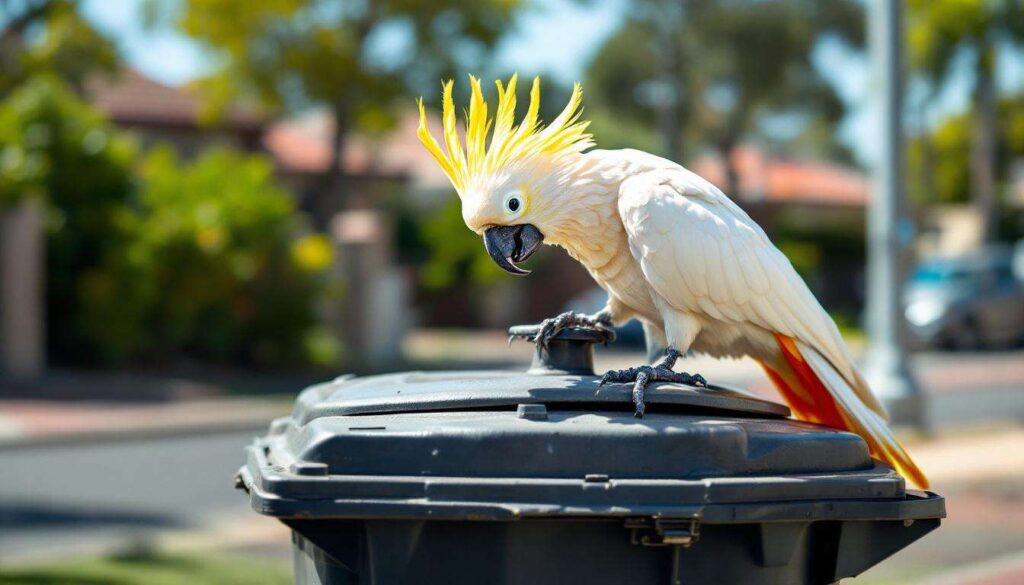
Suburban streets across Australia have become stages for an unexpected display of problem-solving prowess. Sulfur-crested cockatoos, large white parrots native to the continent, have learned to flip open household garbage bins to access food scraps inside. This behavior, first documented in Sydney’s suburbs, has spread across multiple neighborhoods, capturing the attention of researchers who see it as compelling evidence of animal intelligence. The phenomenon represents more than simple foraging; it demonstrates cultural transmission and innovative thinking among wild bird populations.
Introduction to cockatoo behaviors
Natural characteristics of sulfur-crested cockatoos
Sulfur-crested cockatoos are highly social birds that inhabit Australia’s eastern and northern regions. These parrots display remarkable adaptability in urban environments, where they have learned to exploit human-modified landscapes for survival. Their natural diet consists of seeds, nuts, fruits, and insects, but urban populations have expanded their menu to include human food waste.
Key behavioral traits include:
- Strong social bonds within flocks
- Complex vocal communication systems
- Extended parental care periods
- High levels of curiosity and exploratory behavior
- Powerful beaks capable of manipulating various objects
Traditional foraging strategies
In their natural habitats, cockatoos employ specialized techniques to access food sources. They use their beaks to crack hard seed pods, strip bark from trees to reach insects, and dig in soil for roots and tubers. These birds demonstrate tool-using capabilities in laboratory settings, though such behavior is less commonly observed in the wild compared to other parrot species.
The transition from natural foraging to exploiting urban resources marks a significant behavioral shift. Understanding how these birds adapted their existing skills to new challenges provides insight into their cognitive flexibility and learning mechanisms.
Evidence of animal intelligence in cockatoos
Defining intelligence in non-human species
Animal intelligence encompasses multiple cognitive abilities, including problem-solving, memory, social learning, and innovation. Scientists measure these capabilities through various criteria that go beyond instinctive behaviors. For cockatoos, the bin-opening behavior demonstrates several hallmarks of intelligence that distinguish learned skills from innate responses.
| Intelligence Indicator | Cockatoo Demonstration |
|---|---|
| Novel problem-solving | Creating new solutions for accessing bins |
| Social learning | Observing and copying techniques from other birds |
| Behavioral innovation | Developing variations on opening methods |
| Memory retention | Remembering successful bin locations |
Comparative cognitive abilities
Research places cockatoos among the most cognitively advanced bird species, alongside corvids and certain other parrots. Laboratory studies have shown that cockatoos can solve multi-step puzzles, understand cause-and-effect relationships, and even demonstrate delayed gratification. The bin-opening behavior provides real-world confirmation of these laboratory findings, showing that cognitive abilities translate into practical survival advantages in urban environments.
These observations have prompted scientists to examine how such intelligence evolved and what selective pressures might have favored its development in parrot lineages.
Observations of Australian scientists
Documentation of the spreading behavior
Researchers from the Max Planck Institute of Animal Behavior and the University of Sydney conducted systematic observations across Sydney suburbs. They documented the geographic spread of bin-opening behavior between different neighborhoods, tracking how the skill moved through cockatoo populations. The study revealed that this wasn’t a case of multiple independent discoveries but rather cultural transmission from bird to bird.
Initial observations showed that only a few innovative individuals discovered the technique. Subsequently, other cockatoos learned by watching these pioneers, creating distinct regional styles of bin opening. Some suburbs developed their own variations, suggesting that local cultures emerged among different cockatoo populations.
Tracking the innovation’s origin and spread
Scientists identified the earliest documented cases in Sydney’s southern suburbs before the behavior spread to northern and western areas. The pattern of spread followed cockatoo movement patterns and social networks rather than random distribution. This geographic progression provided crucial evidence that the behavior was socially learned rather than genetically programmed or independently discovered.
Researchers used citizen science reports and video footage to map the timeline and geography of the phenomenon. The data revealed distinct clusters where the behavior appeared, followed by gradual expansion as birds from different flocks interacted.
Methods used by cockatoos to open bins
Step-by-step opening techniques
The bin-opening process requires a coordinated sequence of actions that cockatoos must perform in the correct order. First, a bird positions itself on the bin lid, typically gripping the rim with its feet. Next, it uses its beak to lift the lid slightly, creating a small gap. The cockatoo then wedges its head under the lid and walks backward along the rim, using its body weight and leg strength to flip the lid open completely.
This technique demands:
- Precise motor control and balance
- Understanding of leverage principles
- Sufficient strength to manipulate the lid
- Persistence through multiple attempts
- Spatial awareness of body positioning
Variations and adaptations
Different cockatoo populations developed distinct variations on the basic technique. Some birds learned to open bins more efficiently by targeting specific lid types, while others adapted their methods based on bin design variations. When humans implemented countermeasures like weights or locks, some cockatoos modified their approaches, demonstrating behavioral flexibility in response to changing challenges.
The emergence of these variations highlights the innovative capacity within cockatoo populations and suggests that problem-solving abilities extend beyond simple imitation to include creative adaptation.
Implications for the study of animal cognition
Cultural transmission in wild populations
The cockatoo bin-opening phenomenon provides rare documentation of cultural evolution in a wild animal population. Unlike laboratory studies, this natural experiment reveals how innovations spread through social networks without human intervention. Scientists can observe the mechanisms of cultural transmission in real-time, tracking which individuals become innovators, early adopters, or late learners.
This research contributes to understanding how animal cultures develop and persist across generations. It demonstrates that non-human species can create and maintain behavioral traditions that aren’t genetically encoded but rather passed through social learning.
Rethinking animal intelligence frameworks
Traditional approaches to studying animal cognition often relied on controlled laboratory experiments. The cockatoo observations suggest that field studies can reveal cognitive abilities that might not emerge in artificial settings. Real-world challenges may elicit problem-solving behaviors that better reflect the full range of an animal’s intellectual capabilities.
These findings encourage researchers to develop new methodologies that combine field observations with experimental approaches, creating more comprehensive models of animal intelligence.
Prospects for human-cockatoo coexistence
Managing urban wildlife conflicts
As cockatoos continue refining their bin-opening skills, communities face challenges in managing garbage while respecting wildlife. Some residents have implemented physical deterrents, including weighted lids, bricks, and specialized locks. However, the ongoing adaptation by cockatoos creates an evolutionary arms race between human countermeasures and bird ingenuity.
Sustainable solutions require balancing human needs with wildlife welfare. Approaches include:
- Designing bird-proof bins that don’t harm animals
- Adjusting collection schedules to minimize bin exposure
- Educating communities about cockatoo behavior
- Creating alternative food sources in appropriate locations
Appreciating cognitive complexity in urban wildlife
The cockatoo phenomenon offers opportunities for public engagement with wildlife intelligence. Rather than viewing these birds solely as pests, communities can recognize them as cognitively sophisticated neighbors. This perspective shift may foster greater conservation awareness and support for protecting urban biodiversity.
Educational programs highlighting cockatoo intelligence can transform human-wildlife interactions from conflict to coexistence, encouraging residents to appreciate the remarkable cognitive abilities of the animals sharing their urban spaces.
The bin-opening cockatoos of Australia demonstrate that animal intelligence extends far beyond laboratory settings into everyday urban environments. Australian scientists have documented compelling evidence of problem-solving, social learning, and cultural transmission among wild cockatoo populations. These birds employ sophisticated multi-step techniques to access garbage bins, with behaviors spreading through social networks and evolving distinct regional variations. The phenomenon challenges traditional frameworks for understanding animal cognition and highlights the importance of field observations in revealing the full scope of wildlife intelligence. As urban areas continue expanding, fostering coexistence with cognitively complex species like cockatoos requires recognizing their remarkable abilities while developing management strategies that respect both human needs and animal welfare.