



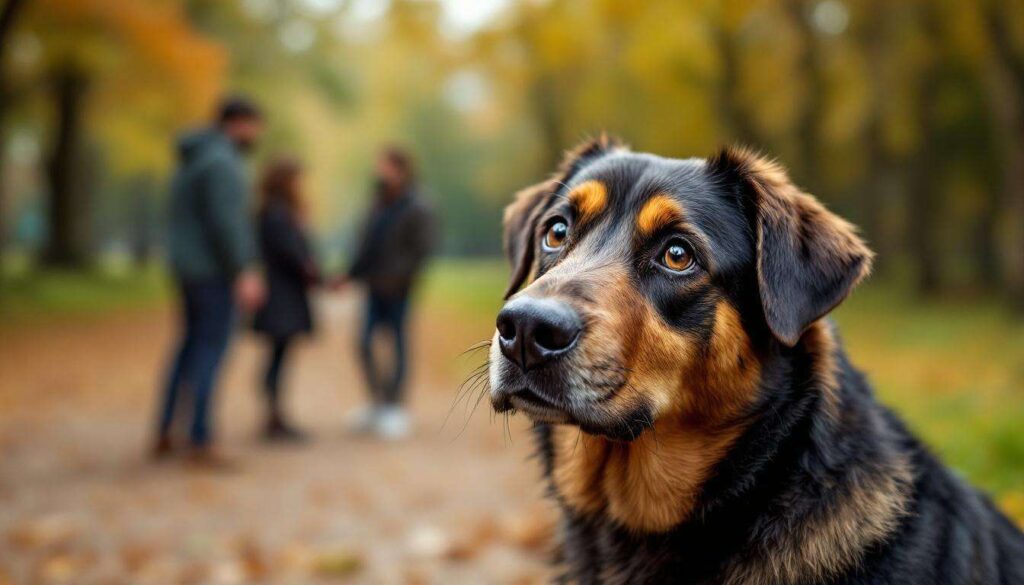
Dogs possess an extraordinary ability to evaluate people within moments of meeting them. Pet owners frequently report instances where their canine companions display immediate wariness toward certain individuals who later prove untrustworthy. This remarkable capacity stems from a combination of heightened sensory perception, behavioral observation skills, and evolutionary adaptations that have refined dogs’ abilities to read both human and environmental cues. Understanding how dogs identify potentially untrustworthy people offers valuable insights into the complex relationship between humans and their four-legged companions, while also providing practical guidance for interpreting these protective instincts.
The dog’s sense of smell: an innate sense for detection
Olfactory capabilities beyond human comprehension
The canine nose contains approximately 300 million olfactory receptors, compared to the mere 6 million found in humans. This biological advantage allows dogs to detect chemical changes and pheromones that remain completely imperceptible to people. When encountering a new person, dogs immediately begin processing an intricate profile of scent markers that reveal emotional states, health conditions, and stress levels.
| Species | Olfactory Receptors | Detection Capability |
|---|---|---|
| Dogs | 300 million | Parts per trillion |
| Humans | 6 million | Parts per billion |
Chemical signatures of dishonesty and fear
Research indicates that stress and deception trigger specific hormonal responses in humans, including elevated cortisol and adrenaline levels. Dogs can detect these chemical changes through scent, allowing them to identify when someone experiences heightened anxiety or displays incongruent emotional states. An individual attempting deception often exhibits physiological stress markers that dogs recognize instinctively.
- Cortisol released during stressful situations
- Adrenaline produced when people feel threatened or dishonest
- Pheromones associated with fear and aggression
- Chemical changes in sweat composition during deception
This sensory information provides dogs with an immediate assessment tool that operates independently of visual or auditory cues, establishing the foundation for their detective-like abilities. These olfactory powers work in concert with other observational skills to create a comprehensive evaluation system.
Scientific studies on canine behavior
Landmark research on social cognition
Scientists at Kyoto University conducted groundbreaking experiments demonstrating that dogs actively evaluate human trustworthiness. In these studies, researchers arranged scenarios where individuals either helped or refused to help the dog’s owner. Dogs subsequently refused treats from people who had been unhelpful, demonstrating their ability to form judgments based on observed social interactions.
Neurological evidence of assessment capabilities
Brain imaging studies reveal that dogs process human facial expressions and vocal tones in specialized regions of their brains. The temporal cortex activation patterns observed when dogs encounter different people suggest sophisticated cognitive processing beyond simple stimulus-response mechanisms. Dogs appear to integrate multiple information sources when forming opinions about individuals.
| Study Type | Key Finding | Institution |
|---|---|---|
| Social cognition | Dogs avoid unhelpful people | Kyoto University |
| Brain imaging | Specialized processing centers | Emory University |
| Behavioral observation | Recognition of deceptive pointing | University of Vienna |
Cross-cultural validation
Studies conducted across multiple countries confirm that this ability transcends breed, training, and cultural context. Whether examining working dogs in law enforcement settings or family pets in domestic environments, researchers consistently observe similar patterns of discriminatory behavior toward individuals displaying untrustworthy characteristics. This universal trait suggests deep evolutionary roots in canine social intelligence.
These scientific findings establish a solid foundation for understanding the mechanisms behind canine judgment, which rely heavily on interpreting the subtle signals humans unconsciously broadcast.
How human body signals are perceived by dogs
Microexpressions and facial recognition
Dogs possess remarkable abilities to read microexpressions that flash across human faces in fractions of a second. These involuntary facial movements often betray true emotions that contradict verbal communication or conscious expressions. When someone attempts to appear friendly while harboring ill intentions, the disconnect between genuine and performed emotions creates signals that dogs readily detect.
Postural cues and movement patterns
Body language provides dogs with extensive information about human intentions and emotional states. Untrustworthy individuals often display specific postural characteristics:
- Rigid or tense body positioning indicating stress
- Erratic or unpredictable movement patterns
- Aggressive gestures disguised as friendly approaches
- Incongruent signals between upper and lower body
- Invasion of personal space boundaries
Vocal tone analysis
The canine auditory system detects subtle variations in vocal pitch, rhythm, and intensity that escape human notice. Deceptive individuals frequently exhibit vocal stress patterns, including higher pitch, irregular cadence, or forced enthusiasm that conflicts with their actual emotional state. Dogs process these auditory inconsistencies as warning signals.
Energy and intention reading
While less scientifically quantifiable, many researchers acknowledge that dogs appear sensitive to what owners describe as energy or intention. This perception likely represents the integration of multiple subtle cues including breathing patterns, muscle tension, and electromagnetic fields produced by the human heart and nervous system. Dogs synthesize these diverse inputs into holistic assessments of trustworthiness.
Beyond these physiological and behavioral signals, real-world accounts provide compelling evidence of dogs’ protective instincts in action.
Real-life experiences: anecdotes and testimonials
Protection from dangerous situations
Numerous pet owners report instances where their dogs’ immediate negative reactions to specific individuals later proved justified. One documented case involved a family dog that consistently barked and positioned itself between children and a seemingly friendly neighbor who was subsequently arrested for criminal activity. These protective behaviors often emerge before any human recognizes potential danger.
Professional settings and working dogs
Law enforcement and security professionals regularly observe how trained detection dogs exhibit behavioral changes around individuals with concealed weapons or contraband, even when those persons attempt to appear calm and cooperative. These dogs respond not only to scent traces but also to the stress signatures of people engaged in deceptive activities.
Domestic scenarios and relationship warnings
Relationship counselors and therapists occasionally hear accounts of dogs displaying persistent hostility toward romantic partners who later revealed problematic behaviors. While not infallible, these canine assessments frequently align with subsequent revelations about:
- Hidden aggressive tendencies
- Substance abuse issues
- Financial dishonesty
- Infidelity or deception
- Controlling or manipulative personalities
Service dogs and vulnerable populations
Service dogs trained to assist individuals with disabilities demonstrate particularly acute abilities to identify threats to their handlers. These dogs receive specialized training that enhances their natural protective instincts, enabling them to recognize and respond to people who might exploit vulnerable individuals. Their assessments provide an additional layer of security for those who might otherwise struggle to identify untrustworthy intentions.
These real-world applications demonstrate why dogs serve as more than companions, functioning as intuitive guardians whose judgments merit serious consideration.
Why dogs are valuable allies for assessing trust
Unbiased evaluation systems
Unlike humans, dogs do not form judgments based on social status, physical appearance, or verbal persuasion. Their assessments rely purely on observable behavioral and physiological signals, making them resistant to the manipulation tactics that deceive people. This objectivity provides a valuable counterbalance to human cognitive biases.
Evolutionary partnership benefits
The domestication process spanning thousands of years has refined dogs’ abilities to interpret human behavior. This co-evolutionary relationship created animals uniquely attuned to human emotional states and social dynamics. Dogs evolved alongside humans specifically to fulfill protective and cooperative roles, making trustworthiness assessment a core competency.
| Human Vulnerability | Canine Advantage |
|---|---|
| Susceptible to charm and manipulation | Responds only to genuine signals |
| Influenced by social pressure | Independent assessment capability |
| Limited sensory perception | Enhanced olfactory and auditory detection |
| Cognitive biases affect judgment | Instinct-based evaluation system |
Early warning system advantages
Dogs provide immediate feedback about new acquaintances, often before extensive interaction occurs. This rapid assessment capability allows owners to exercise additional caution when their pets display warning behaviors, potentially avoiding dangerous situations or problematic relationships before significant investment or vulnerability develops.
Recognizing and properly interpreting these canine warnings requires understanding specific behavioral indicators that signal concern.
Tips for observing and understanding your dog’s reactions
Key behavioral indicators to monitor
Observant owners should watch for specific behaviors that indicate discomfort or distrust when their dogs encounter new people:
- Raised hackles along the spine and shoulders
- Positioning between owner and the other person
- Refusal to accept treats or affection from the individual
- Prolonged staring or fixed attention
- Backing away or attempting to leave the area
- Low growling or warning vocalizations
- Tucked tail combined with tense body posture
Distinguishing fear from protective instinct
Not all negative reactions indicate untrustworthiness in the person. Dogs may respond negatively to individuals who remind them of past negative experiences or who possess characteristics that trigger breed-specific sensitivities. Owners should consider whether the reaction represents general anxiety or specific concern about a particular individual’s trustworthiness.
Contextual assessment strategies
Evaluate your dog’s reactions within broader contexts. A normally friendly dog that displays consistent wariness toward a specific person despite repeated positive interactions warrants attention. Conversely, a generally anxious dog that reacts negatively to most strangers may require behavioral support rather than indicating universal untrustworthiness.
Building trust in your dog’s judgment
Develop confidence in your dog’s assessments by:
- Documenting reactions to different people over time
- Comparing your dog’s judgments with subsequent relationship outcomes
- Consulting with professional trainers about behavioral interpretations
- Respecting your dog’s boundaries when they signal discomfort
- Avoiding forced interactions between your dog and individuals they distrust
Strengthening this partnership between human observation and canine instinct creates a powerful protective alliance that enhances personal safety and relationship quality.
The remarkable capacity of dogs to identify untrustworthy individuals within seconds represents a sophisticated integration of sensory perception, behavioral observation, and evolutionary adaptation. Their superior olfactory capabilities detect chemical signatures of stress and deception, while their acute awareness of body language, facial expressions, and vocal patterns provides comprehensive assessment tools. Scientific research validates these abilities through controlled studies demonstrating social cognition and discriminatory behavior toward unhelpful or deceptive individuals. Real-world testimonials consistently confirm that canine judgments frequently prove accurate, offering valuable protection in both domestic and professional contexts. By learning to recognize and interpret the warning signs dogs display, owners can leverage this natural detective ability to make more informed decisions about the people they allow into their lives. This ancient partnership between humans and dogs continues to provide practical benefits, with canine intuition serving as a reliable supplement to human judgment in assessing trustworthiness and maintaining personal safety.