



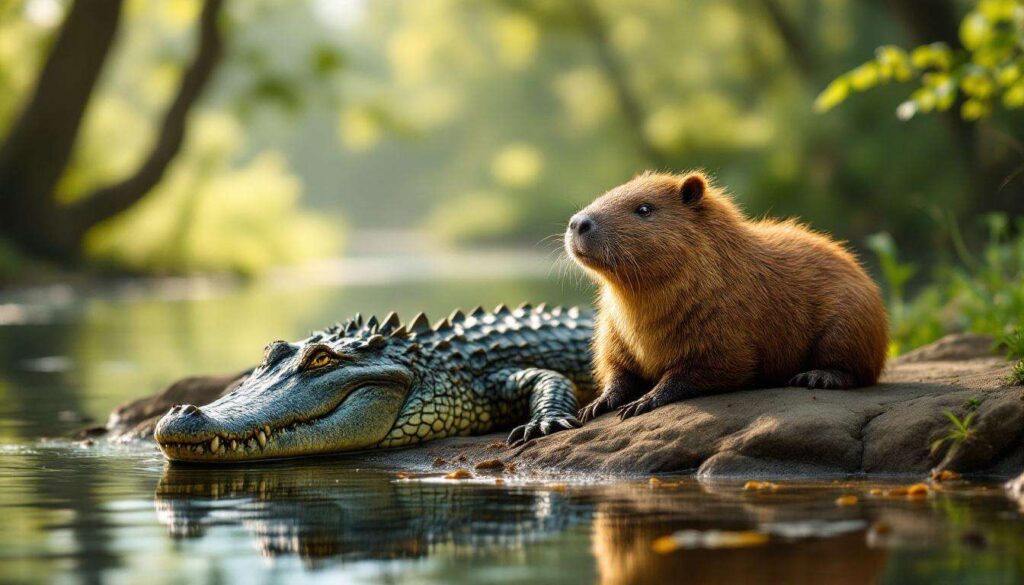
Across the wetlands of South America, an unusual phenomenon has captured the attention of wildlife observers and scientists alike. Crocodiles, fearsome predators known for their powerful jaws and opportunistic hunting tactics, frequently share territory with capybaras without attacking them. This peaceful coexistence between a top predator and what appears to be vulnerable prey challenges conventional understanding of predator-prey dynamics. The relationship raises fundamental questions about animal behavior, ecological balance, and survival strategies that have evolved over millennia in shared habitats.
Introduction to the crocodile-capybara relationship
Geographic overlap and habitat sharing
Crocodiles and capybaras inhabit overlapping territories throughout South American wetlands, particularly in regions such as the Pantanal, the Llanos, and various river systems across Brazil, Venezuela, and Colombia. These ecosystems provide abundant water sources where both species congregate for different purposes. Capybaras, being semi-aquatic rodents, depend on water for thermoregulation and protection from terrestrial predators, while crocodiles use these same waterways as hunting grounds and resting areas.
The spatial distribution of these animals creates frequent encounters. Capybaras often graze along riverbanks and wade into shallow waters, placing them in direct proximity to caimans and crocodiles. Despite this regular interaction, violent confrontations remain remarkably rare. Observers have documented capybaras resting mere feet away from basking crocodiles, with neither species showing signs of aggression or fear.
Historical documentation of peaceful coexistence
Wildlife photographers and researchers have compiled extensive evidence of this peaceful relationship over decades. The phenomenon is not isolated or anecdotal but represents a consistent pattern observed across multiple geographic locations and crocodilian species. Documentation includes:
- Photographic evidence of capybaras swimming past crocodiles without evasive behavior
- Video recordings showing young capybaras playing near adult caimans
- Field notes from biologists documenting shared basking sites
- Long-term observational studies tracking interaction frequencies
This body of evidence suggests that the relationship is not merely coincidental but reflects deeper ecological and behavioral factors that govern interactions between these species.
Understanding why this truce exists requires examining the characteristics that make capybaras unique among potential prey species.
Capybaras: potential prey, but why spared ?
Physical characteristics and size considerations
Capybaras are the world’s largest rodents, with adults weighing between 77 and 146 pounds and measuring up to 4.4 feet in length. This substantial size presents significant challenges for predators. While crocodiles can certainly take down large prey, the effort-to-reward ratio becomes an important consideration in predatory decision-making.
| Characteristic | Adult Capybara | Hunting Challenge |
|---|---|---|
| Weight | 77-146 lbs | Requires significant energy expenditure |
| Social structure | Groups of 10-20 | Multiple vigilant individuals |
| Defensive capability | Strong swimmers, alert | High escape success rate |
Group dynamics and collective vigilance
Capybaras are highly social animals that live in groups ranging from 10 to 20 individuals, though larger congregations can form during dry seasons. This social structure provides a significant defensive advantage through collective vigilance. Multiple sets of eyes and ears increase the likelihood of detecting threats early, allowing the group to respond before a predator can launch a successful attack.
The alarm system within capybara groups is sophisticated. When one individual detects danger, it emits warning vocalizations that trigger immediate group responses. This coordinated reaction makes ambush hunting, which crocodiles rely upon, considerably less effective against capybaras compared to solitary or less vigilant prey species.
These defensive adaptations exist within a broader ecological context that influences predator-prey interactions.
The ecosystem and the abundance of resources
Diverse prey availability in shared habitats
The wetland ecosystems where crocodiles and capybaras coexist support remarkably diverse fauna. These environments teem with alternative prey options that require less effort and risk for crocodiles to capture. The abundance of easier targets reduces the selective pressure on crocodiles to develop specialized hunting strategies for capybaras.
Available prey species in these ecosystems include:
- Fish populations of various species and sizes
- Water birds including herons, ducks, and wading species
- Smaller mammals such as coatis and agoutis
- Reptiles including snakes and turtles
- Amphibians during breeding seasons
Energy economics of predation
Predators operate under energetic constraints that govern their hunting decisions. The energy gained from consuming prey must exceed the energy expended in capturing it, factoring in the success rate of hunting attempts. For crocodiles, targeting capybaras presents an unfavorable cost-benefit analysis compared to other available prey.
Smaller prey items such as fish can be captured with minimal energy expenditure and high success rates. While a single capybara provides more calories than a fish, the difficulty of capture, the low probability of success, and the potential for injury during the hunt make this option less attractive when abundant alternatives exist.
Beyond resource availability, the specific behaviors of capybaras further explain their immunity from predation.
Survival strategies and behaviors of capybaras
Temporal patterns and activity timing
Capybaras have evolved behavioral patterns that minimize their vulnerability to predators. They are primarily crepuscular, meaning they are most active during dawn and dusk when visibility conditions reduce predator effectiveness. During midday heat, they rest in shaded areas or partially submerged in water, while nighttime activity is limited and cautious.
This temporal partitioning reduces overlap with peak crocodile hunting periods. Crocodiles are ambush predators that rely heavily on visual cues and optimal lighting conditions for successful strikes. The timing of capybara activity patterns naturally reduces encounters during the most dangerous periods.
Water navigation and escape tactics
Despite being prey animals, capybaras are exceptional swimmers with adaptations that rival those of their predators. They possess webbed feet, streamlined bodies, and can remain submerged for up to five minutes. These capabilities allow them to navigate aquatic environments with remarkable efficiency.
When threatened, capybaras employ several escape strategies:
- Rapid entry into water from land positions
- Prolonged submersion to evade surface predators
- High-speed swimming in unpredictable patterns
- Use of dense vegetation for cover during escapes
The success rate of these escape tactics makes hunting capybaras a low-probability endeavor for crocodiles, further discouraging predatory attempts.
These prey behaviors interact with the dietary preferences and hunting strategies of crocodiles themselves.
Crocodile diets: opportunism and preferences
Feeding ecology of crocodilians in South America
Crocodilians inhabiting South American wetlands, primarily caimans of various species, display opportunistic feeding behaviors shaped by availability, vulnerability, and capture efficiency. Their diets vary seasonally and geographically but consistently favor prey that offers optimal return on hunting investment.
Research on caiman stomach contents reveals dietary composition heavily weighted toward:
| Prey Category | Percentage of Diet | Capture Difficulty |
|---|---|---|
| Fish | 45-60% | Low |
| Aquatic invertebrates | 15-25% | Very low |
| Birds | 10-20% | Medium |
| Small mammals | 5-15% | Medium |
Risk assessment in predatory behavior
Crocodiles, despite their reputation as fearsome predators, are risk-averse hunters that avoid confrontations with prey capable of inflicting injury. Adult capybaras possess powerful jaws with large incisors designed for cutting vegetation, which could potentially cause damage to a crocodile during a struggle. The possibility of injury, combined with low capture probability, makes capybaras an unattractive target.
Additionally, crocodiles exhibit learned behavior patterns passed through generations. If previous hunting attempts on capybaras proved unsuccessful or costly, this information influences future hunting decisions. The collective hunting memory of crocodile populations may reflect generations of unsuccessful capybara hunts, reinforcing avoidance of these prey.
Scientific investigation has provided additional insights into this remarkable relationship.
Scientific studies: field observations and hypotheses
Research findings from the Pantanal and Llanos
Extensive field studies conducted in the Pantanal wetlands of Brazil and the Llanos of Venezuela have documented the crocodile-capybara dynamic with quantitative rigor. Researchers have employed camera traps, radio telemetry, and direct observation to track interaction frequencies and outcomes.
Key findings from these studies include:
- Documented interaction events number in the thousands with predation events remaining statistically insignificant
- Juvenile capybaras show higher vulnerability but still experience low predation rates
- Seasonal variations in water levels correlate with interaction frequencies but not predation rates
- Crocodile hunting success rates on capybaras measure below 5% in observed attempts
Theoretical frameworks explaining the truce
Scientists have proposed several complementary hypotheses to explain this phenomenon. The optimal foraging theory suggests that predators maximize energy intake while minimizing energy expenditure and risk. Under this framework, capybaras fall outside the optimal prey profile for crocodiles given available alternatives.
The predator-prey coevolution hypothesis posits that capybaras and crocodiles have evolved together over millions of years, developing a stable equilibrium where predation attempts are so rarely successful that they have been essentially eliminated from crocodile hunting repertoires. This evolutionary perspective suggests that the current relationship represents an endpoint of long-term ecological dynamics rather than a temporary phenomenon.
Additional research focuses on chemical communication, with some scientists investigating whether capybaras produce deterrent compounds or signals that discourage predatory behavior. While this remains speculative, it represents an intriguing avenue for future investigation.
The relationship between crocodiles and capybaras exemplifies the complexity of predator-prey dynamics in biodiverse ecosystems. Multiple factors converge to create this peaceful coexistence: the substantial size and social nature of capybaras, their effective escape strategies, the abundance of alternative prey, and the unfavorable cost-benefit analysis of hunting them. Scientific observations across South American wetlands consistently document this pattern, suggesting it represents a stable ecological relationship rather than an anomaly. Understanding such interactions enriches our comprehension of how species coexist and adapt within shared habitats, demonstrating that nature’s rules are far more nuanced than simple predator-prey dichotomies suggest.