



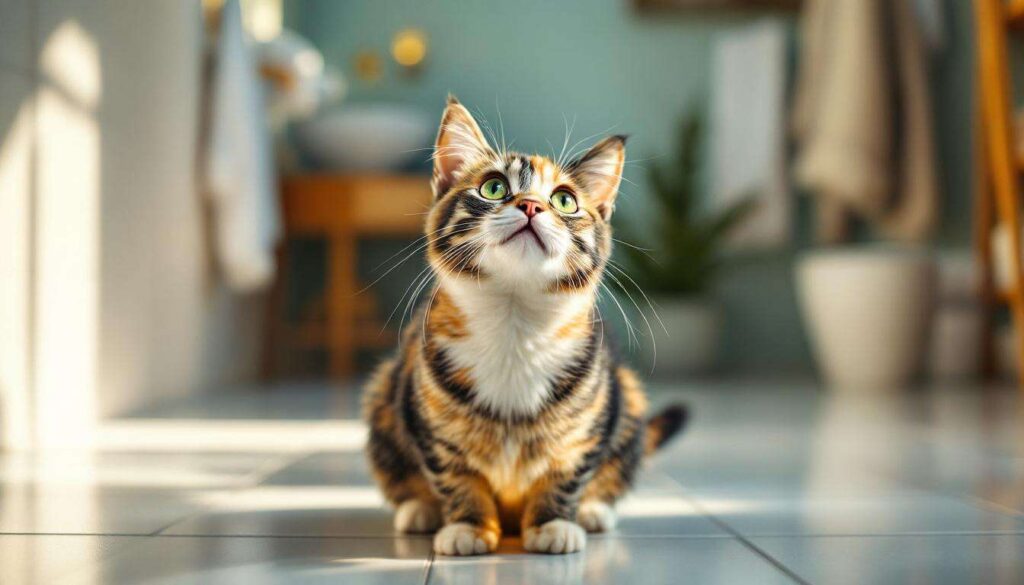
Your feline companion’s persistent presence during your most private moments might seem puzzling, but according to zoologists, this behavior reveals fascinating insights into cat psychology and domestication. When your cat squeezes through the bathroom door or meows insistently outside, they’re displaying behaviors rooted in millions of years of evolutionary development. Understanding why cats follow their owners to the bathroom requires examining their natural instincts, social structures, and unique relationship with humans. This seemingly quirky habit actually demonstrates several fundamental aspects of feline behavior that experts have studied extensively.
Natural feline behavior: an instinctive closeness
Ancestral pack mentality in domestic cats
Despite their reputation for independence, cats evolved from ancestors who exhibited social hunting patterns and formed loose colonies. Zoologists explain that domestic cats retain many behaviors from their wild counterparts, including the tendency to remain near trusted companions. This instinctive closeness manifests in various ways:
- Following family members from room to room throughout the day
- Sleeping near or on their preferred humans during nighttime
- Monitoring activities of household members from strategic vantage points
- Vocalizing when separated from their human companions
Territorial monitoring instincts
Cats view their living environment as personal territory that requires constant surveillance. The bathroom represents a confined space within this territory, and your presence there triggers monitoring behavior. Zoologists note that cats feel compelled to investigate any activity occurring within their domain, particularly when it involves their primary caretaker. This territorial awareness developed as a survival mechanism, helping wild cats protect resources and identify potential threats. Your bathroom visit becomes an event worthy of investigation simply because it occurs within the cat’s perceived territory.
These instinctive behaviors naturally extend to how cats form relationships with their human companions, creating bonds that influence their daily interactions.
The social bond between the cat and its human
Attachment patterns similar to kitten-mother relationships
Research by animal behaviorists demonstrates that cats develop attachment styles with their owners that mirror the bonds between kittens and their mothers. This relationship creates a dependency that manifests through following behavior. Zoologists have identified specific indicators of this attachment:
| Attachment Behavior | Frequency in Bonded Cats | Significance |
|---|---|---|
| Following to bathroom | 78% of indoor cats | High trust indicator |
| Waiting outside closed doors | 65% of bonded cats | Separation anxiety signal |
| Vocalizing during separation | 52% of attached cats | Communication attempt |
Recognition of vulnerability in confined spaces
Cats possess remarkable observational skills and recognize when their humans enter small, enclosed spaces. Zoologists explain that cats understand vulnerability differently than humans do. In the wild, confined spaces present both opportunities and dangers. Your cat follows you to the bathroom partly because they recognize this as a moment when you’re stationary and contained, similar to how cats check on their kittens in dens or nesting areas. This protective instinct demonstrates the depth of the social bond between cat and owner.
Beyond social attachment, cats also seek specific emotional benefits from maintaining proximity to their humans.
The need for security and reassurance
Mutual comfort in shared spaces
The bathroom following behavior often intensifies during periods when cats experience environmental stress or changes in household routine. Zoologists observe that cats derive comfort from the presence of their trusted humans, particularly in situations that might otherwise cause anxiety. The bathroom becomes a sanctuary where the cat can:
- Maintain visual contact with their primary attachment figure
- Access physical touch and petting during vulnerable moments
- Escape from other household pets or disturbances
- Establish routine patterns that provide predictability
Response to household dynamics
In multi-pet households, the bathroom represents a controlled environment where cats can claim exclusive access to their preferred human. Zoologists note that cats who share living spaces with dogs or other cats frequently use bathroom time as an opportunity for one-on-one interaction. This behavior intensifies when cats feel competition for attention or resources. The closed door creates a temporary barrier that excludes other animals, allowing the cat to monopolize your attention without interference.
This desire for security intertwines closely with another fundamental feline characteristic that draws cats to unusual locations.
Feline curiosity: exploring unusual territories
Investigation of water sources and sounds
Bathrooms contain elements that trigger intense curiosity in cats, particularly water-related features. Zoologists explain that cats evolved in arid environments where water sources required careful monitoring. Despite domestication, cats retain fascination with running water, dripping faucets, and toilet bowls. Your bathroom visit provides opportunities for cats to:
- Observe water flowing from taps and showerheads
- Investigate steam and humidity changes
- Monitor unfamiliar sounds like flushing and draining
- Explore reflective surfaces and mirrors
Sensory stimulation in confined environments
The bathroom offers concentrated sensory experiences that appeal to feline investigation instincts. Zoologists note that cats process sensory information differently than humans, finding interest in temperature variations, air currents, and acoustic properties of tiled spaces. The confined nature of bathrooms amplifies sounds and concentrates scents, creating an environment rich with stimulation. Your cat’s presence during bathroom activities represents their desire to experience these sensory changes firsthand, satisfying their innate curiosity about environmental variations.
While curiosity plays a significant role, cats also recognize bathroom visits as opportunities for specific types of interaction with their owners.
Privileged time and exclusive attention
Captive audience phenomenon
Zoologists identify bathroom following as a strategic behavior where cats exploit their owner’s temporary immobility. Unlike other household activities where humans move freely and divide attention among multiple tasks, bathroom time creates a captive audience. Cats learn through observation that humans remain stationary during these moments, making it ideal for:
| Interaction Type | Success Rate | Cat Benefit |
|---|---|---|
| Receiving petting | 85% | Physical affection |
| Getting verbal attention | 92% | Social interaction |
| Soliciting play | 68% | Entertainment |
Learned patterns of reward
Through behavioral conditioning, cats discover that bathroom visits often result in positive interactions. Zoologists explain that if owners consistently pet, talk to, or acknowledge their cats during bathroom time, this reinforces the following behavior. Cats possess excellent associative memory and quickly learn which behaviors yield desired outcomes. The bathroom becomes associated with guaranteed attention, making it a preferred location for seeking interaction. This learned behavior strengthens over time, becoming an established routine that cats anticipate and initiate.
Understanding these motivations helps owners navigate the balance between meeting their cat’s needs and maintaining appropriate boundaries.
Understanding and respecting its personal space
Recognizing individual preferences
Not all cats display bathroom following behavior with equal intensity, and zoologists emphasize the importance of recognizing individual personality differences. Some cats prefer minimal human interaction, while others demand constant proximity. Respecting these variations requires observing your cat’s specific communication signals:
- Tail position and movement indicating comfort levels
- Vocalization patterns expressing different needs
- Body posture revealing stress or contentment
- Approach and retreat behaviors showing boundaries
Balancing access with boundaries
While bathroom following demonstrates healthy attachment, zoologists recommend establishing boundaries that work for both cat and owner. Cats benefit from learning that closed doors don’t indicate abandonment or danger. Providing alternative comfort sources helps cats develop independence while maintaining security. Creating designated spaces where cats receive attention at scheduled times can reduce persistent following behavior. However, completely denying access may increase anxiety in cats who rely on this routine for emotional regulation.
Your cat’s bathroom companionship reflects complex interplay between instinct, learned behavior, social bonding, and curiosity. Zoologists confirm that this behavior indicates trust and attachment rather than dependency issues in most cases. The bathroom represents a convergence of factors that appeal to feline psychology: confined territory requiring monitoring, opportunities for exclusive attention, sensory stimulation, and proximity to trusted companions. Understanding these motivations allows owners to appreciate their cat’s presence while establishing appropriate boundaries. Whether you welcome your feline bathroom companion or prefer privacy, recognizing the underlying reasons for this behavior strengthens the human-cat relationship and provides insight into the fascinating world of feline cognition and social structures.